The Final 27 Days with my Grandfather


May 3, 2026: 27 days
Soon after getting off the 15-hour flight from Chicago, I arrive at my aunt's apartment in Taipei, where my grandfather has lived for the past five years. Being a man in his nineties, he had already seen his share of health struggles, but the past two years brought an even steeper decline. He began spending most of his time indoors, visiting the emergency rooms every few months, and losing his appetite. Even so, whenever I visited him during my summer breaks from the U.S., he always found the strength to join me for a meal in the dining room, offer some words of wisdom about life, listen to my updates about school, and — as most Asian grandparents love to do — slip me some extra pocket money.
But this time is different.
As I enter his bedroom, I barely recognize the person lying there — just skin and bones. His cheeks and eye sockets are so hollow that I can trace the shape of his skull beneath them. His eyes are shut, his mouth open, and his breathing labored. Sitting beside his bed, I notice there's barely any moisture on his lips or in his mouth. When my aunt turns up the light and tells him I've arrived, he strains to open his eyes and pushes out a few mumbled sounds. I have to lean in and ask him to repeat himself three times before I understand: he's asking if I've eaten lunch yet.
"He hasn't eaten anything in three days" my aunt says. My arrival seems to stir some faint energy in him. He asks for pumpkin soup, and with my aunt's help, manages to sip down half a bowl.
Until today, I never realized how difficult daily routines are when your muscles don't have your back anymore. Every swallow, every cough, every turn of the head, and every opening of the eyes looks like pushing against a heavy resistance. He cannot even lift his head or his hands without the help of others. Though he always opens his eyes when we speak to him, he seems to slip right back into a light sleep the moment nothing external stimulates him to stay awake, as if his body is conserving what little energy it has left.
May 5, 2026: 25 days
Did you know that in a chameleon's final moments, its body erupts into rapid, vivid color changes? This happens because its nervous system can no longer control the pigment cells in its skin. The colors would spark and dance like one last celebration of life. I can't help but feel the neural network works the same way just before a person passes: pathways become disinhibited, and core memories resurface like a final wave of fireworks.
That's exactly what happened during my visit today. My grandfather's consciousness drifts across several stages of his life.
For one moment, he is back in the army, asking whether his shift is over.
For one moment, he is back home with my grandmother, asking whether dinner is ready.
For one moment, he is at my aunt's place five years ago, checking in with me about my transition from community college near the Bay Area to my university near Los Angeles.
As I hold his hand and massage his legs, I notice how much skinnier his limbs look next to mine. The contrast between our arms feels like a warning: that time will eventually wash away all my badges of youth — my physique, the vibrant color of my skin, even my grip. Who will be the one holding my hand then?
May 29, 2026: 2 days
I'm in the middle of a workout when my aunt messages. She's not sure if grandfather will make it through the night. I immediately take off and head to her place. The only light in the room comes from a dimmed lamp on the bedstand, and the air is faintly saturated with the aroma of tea tree oil from the diffuser. Several people are gathered around Grandpa's bed: my three aunts, my parents, two of his friends, and a family friend who is a pastor. My aunt gently lifts the blanket to show me his feet. They've turned dull grey, as if the body is going lights-out from the bottom up, as if the bloodstreams are drying up from the tips.
The pastor tells me to hold my grandpa's hand, and we begin to say our farewells. It's a deeply uncomfortable experience. I feel like I can't breathe as the words push out of my mouth: "Don't worry about me, Grandpa. I'll be fine. We're all here." My grandfather breathes heavily, eyes closed, eyebrows knitted, as if he's in a great deal of pain. The pastor gently comforts him, telling him that God will welcome him into His arms, that my grandfather has been a kind, just, and caring person. He tells my grandfather that he is accompanied by people who love, respect, and appreciate him. As the pastor recites passages from the Bible, my grandpa responds, again and again, with "amen." I'm amazed by the strength in his voice — from a man who hasn't had a sip of water in two days. (Grandfather refused to drink anything, so my aunt could only moisten his lips and mouth with a Q-tip to prevent them from drying out). Faith, it seems, is the last thing still charging his voice.
May 30, 2026: 1 day
Grandfather falls into a coma - blood oxygen level is nearly undetectable.
May 31, 2026, 9:45 am: Grandfather passes away at the age of 98
June 13: The Funeral
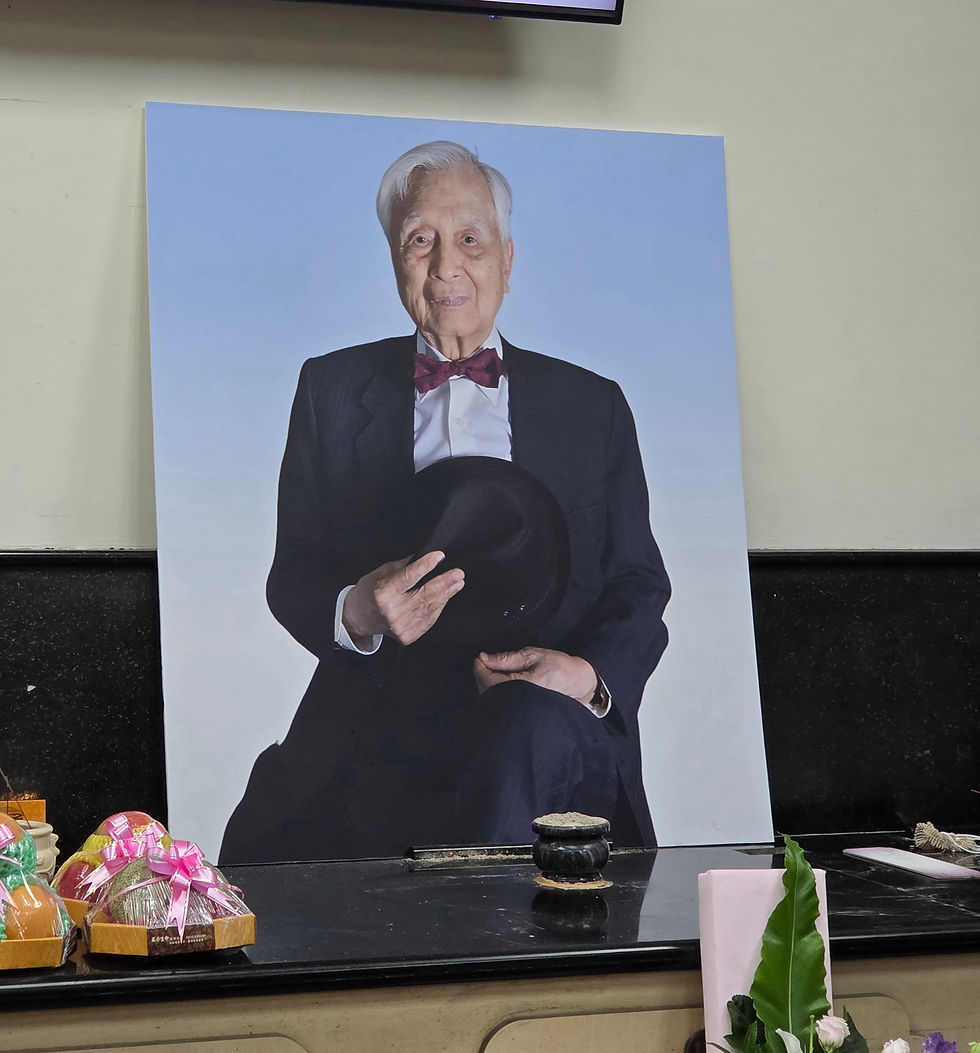
The last time I attended a family member's funeral was my grandmother's in 2015. I was twenty-one at the time. Although it's been more than ten years, I vividly remember that I was surprised at myself for NOT being taken over by emotion at her funeral. I suppose it was because it was the first funeral I'd ever attended. I simply couldn't make sense of the situation yet. Perhaps I built a fortress that shielded me from all the emotions at that time.
At my grandfather's funeral, though, grief runs through my system entirely. Emotions rise like tides at every stage of the ceremony.
I weep when I see him one last time, lying in his casket.
I weep when his life-story tribute video is played.
I weep when I watch his casket enter the cremation chamber.
As his eldest grandson, I carry the urn of his ashes. The car takes me to the memorial garden where my grandmother's ashes are kept. For eleven years, her ashes have rested in a niche that my family and I visit every year. This year, the niche is reopened one last time. My grandfather's name is added, his urn carefully placed beside my grandmother's, and the niche is sealed once more.
In Chinese culture, it's often said that a deceased spirit will be reincarnated as an insect (such as a butterfly) or other insects or small animals and visit the family soon after passing. I'd always found this superstition amusing. But as I stand in the memorial garden today, I notice something curious: a tiny, light-green jumping spider. It hops onto the back of my hand and makes its way up my arm. I blow it off, but later find it back on my arm again. In that moment, I feel a little lighter.
Final Thoughts

Still from A Monster Calls (2016), courtesy of Focus Features. (via IMDb)
In the film adaptation of the children's book A Monster Calls, thirteen-year-old Conor faces a series of upheavals as his mother battles terminal cancer. In response to this distressing experience, his mind conjures a tree monster who visits him at night. The monster tells him three tales, each mirroring a piece of Conor's current struggles. Toward the end of the story, the monster pushes Conner to tell the fourth tale - one that embodies Conner's recurring nightmare. Conor finally recognizes and speaks the truth that has lain buried in his subconscious — that some part of him wishes for his mother to go, so that both her suffering and his own can finally come to an end. Confronting this truth ultimately allows Conor to make peace with his fear and give voice to his farewell.
There were multiple times in the last 27 days with my grandfather when I thought of this movie. Spending time with my grandfather during these final moments was the closest I've ever come face-to-face with death. I have to admit that it really scared me, and I don't know if I can ever completely overcome this fear. It's a survival instinct after all - to want to run away from death. That's exactly what I did before my grandmother passed in 2015. My grandmother suffered from dementia in her final years. As a young adult in my early twenties, I couldn't bring myself to confront the fact that the woman who had loved and raised me had become someone who no longer recognized me. I didn't want to immerse myself in the knowledge that death is approaching her. As a result, I did not visit her during the last few years of her life. It wasn't until her funeral that I saw her face one last time. This guilt and dissonance haunted me for years. I hated myself for my cowardice.
My fear of seeing death approaching my loved ones didn't fade as I grew older. However, I was much more courageous this time when I noticed that my grandfather was fading. A part of me still wanted to run, and it took tremendous effort to watch him deteriorate and embrace him at his most vulnerable.
But I'm so glad that I did.
I feel at peace knowing that he knew I was there. I'm glad I was one of the final snapshots he took away from this world. I'm glad I was one of the last hands he felt on his arm. I'm glad he was able to ask about my life one last time. I'm glad he was surrounded by people who loved him and brushed by the words of God before he departed. I'm glad I was able to quietly sit with my grandpa and death in the same room.


Comments